The Truth About Korean Skincare
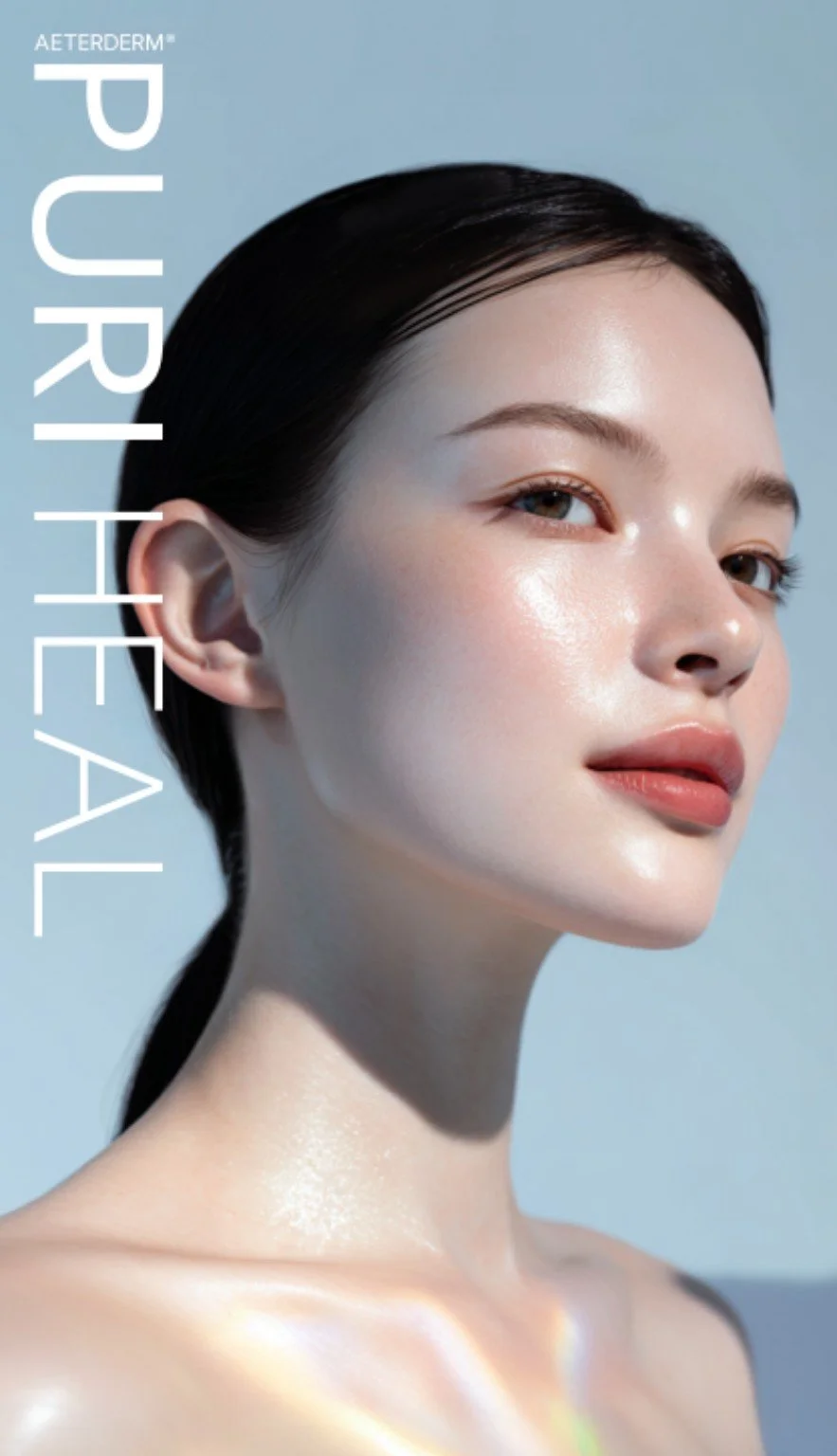
This image came directly from the website of a professional skincare brand I encountered at a recent trade show. Whether AI generated or heavily retouched, this isn't realistic skin. Real skin has pores, texture, and variation.
Korean skincare is everywhere right now. Scroll through TikTok or Instagram and you'll see glass skin, snail mucin, PDRN, 10 step routines, skin flooding and product after product promising smoother, brighter, seemingly poreless skin. Walk through a beauty store or, in my case, a professional esthetics trade show, and you'll see the same thing. Korean skincare is having a moment.
And as an esthetician, I'm going to say something that might be unpopular:
Just because it's Korean skincare doesn't mean it's good skincare.
That doesn't mean there aren't excellent skincare products made in Korea. There absolutely are. But somewhere along the way, Korean skincare itself became a selling point. I've watched people start treating the label as though it automatically means a product is cleaner, gentler, more innovative or better formulated. It doesn't. And lately, I'm seeing the consequences of that assumption in my treatment room…
When Your Skin Is Telling You Something Isn't Working
I've had clients come in dry, dehydrated, irritated, breaking out or dealing with a compromised barrier and tell me they're using an entire routine of Korean skincare. Sometimes they're so convinced that K-beauty is inherently better that they're hesitant to change anything, even though their skin is telling us something isn't working.
At some point, we have to stop listening to the marketing and start listening to the skin.Your skin doesn't know that a product went viral. It doesn't know how many TikTok views it has. It doesn't care whether the bottle says Korean skincare or whether an influencer calls it their holy grail.
Your skin responds to the formulation you're putting on it and whether that formulation is appropriate for your individual skin. The goal shouldn't be to have a Korean skincare routine; the goal should be to have products that are appropriate for YOUR skin,
Is the K-Beauty Going Viral Here Actually What's Popular in Korea?
There's another assumption I hear frequently. If a Korean skincare product goes viral in the United States, it must be what everyone in Korea is using too. That's not necessarily true.
There are Korean brands and products that are popular both domestically and internationally, but the products dominating American TikTok and Instagram don't necessarily represent the entire Korean skincare market. Sometimes there's also an unspoken story being sold alongside them:
Korean people have beautiful skin. This is Korean skincare. Therefore, this must be what they're using to get that skin.
That's a pretty big leap. Skincare is only one factor affecting someone's appearance. Genetics, age, hormones, climate, lifestyle, sun exposure, professional treatments, medications, injectables, makeup and countless other factors influence what you're seeing.
Then there are filters and editing. Buying Korean skincare doesn't mean you're buying "Korean skin." More importantly, you shouldn't be choosing your skincare based on the model advertising it anyway. You should be choosing it based on your own skin type and concerns.
I Saw the K-Beauty Hype Up Close
This really hit home for me recently while attending a professional esthetics trade show. Korean skincare was everywhere. Booth after booth was leaning into K-beauty, glass skin, trendy ingredients and beautiful imagery.
One thing that stood out to me was transparency. Some of the samples and product information I encountered were primarily in Korean, making it difficult to determine exactly what was in the formula. I've also researched products where the company's website highlighted a handful of main ingredients and then literally ended the list with "etc."
As a professional, that's not enough for me. If I'm considering putting something on someone's skin, I want the complete ingredient list, not just the ingredients a company wants to highlight. I want to know about preservatives, fragrance, potential sensitizers and allergens, animal-derived ingredients and anything else that could affect how I use the product. I can't properly vet what I can't identify.
I'm also asking questions. Where was the company founded? Where was the product formulated and manufactured? What testing has been done? What's the delivery system? What makes the formulation different?Sometimes the answers didn't match the impression the marketing initially gave me. That doesn't automatically make a product bad, but it does mean you shouldn't let a marketing category make the decision for you.
Korean Doesn't Mean Clean
One of the biggest misconceptions I hear is that Korean skincare is somehow synonymous with clean skincare. It's not at all.
Korean skincare isn't an ingredient standard, and clean doesn't have one universal definition either. That's why I care much more about what a company actually does than which buzzwords appear on its packaging.
As an esthetician, friends love gifting me skincare. One Korean sheet mask I received was marketed around hydration and calming ingredients. The packaging was adorable, and I actually loved that the masks weren't individually wrapped and came with little tongs to remove them.
Then I looked at the formulation. It contained multiple stimulating essential oils, something I personally wouldn't choose for a product being promoted primarily as gentle and calming. I tried it anyway and my skin started burning. I initially wondered whether my skin was simply irritated that day because I had gone swimming, so I gave it another chance on a different day.
Same reaction. That doesn't mean every Korean sheet mask is irritating. It means Korean didn't tell me whether that particular formulation was appropriate for my skin.
If clean beauty matters to you, figure out what your standards actually are and then look beyond the buzzword.
Snail Mucin and the Power of Marketing
Then we have snail mucin. I'll admit this is one trend I have a particularly hard time understanding. If a snail crawled across your kitchen counter, would you look at the trail it left behind and think, Perfect. Let me put that on my face?
But call it snail mucin, put it in beautiful packaging, surround it with glass skin marketing and make it viral on social media, and suddenly people can't get enough of it.That's the power of marketing.
There may be components of snail secretion that are interesting from a skincare perspective, but my question is what this ingredient uniquely accomplishes that warrants the amount of hype surrounding it. We already have well established ingredients and formulations for hydration and barrier support.
Animal welfare matters to me personally, too. I tend to gravitate toward vegan, plant-based and cruelty-free products when effective alternatives are available. And remember, vegan and cruelty-free don't mean the same thing. A product can be considered cruelty-free under a company's standards because it isn't tested on animals while still containing animal-derived ingredients.
Personally, my standards go further than animal testing. If an animal was required to source an ingredient, I want to know how that ingredient was obtained and what ethical and sustainability standards are behind it.
I even came across a snail mucin product while researching one of the brands I saw at the trade show that prominently used the word "vegan." Snail secretion is 100% animal-derived. That's the kind of contradiction that makes me stop and question the rest of a company's claims.
Have You Heard of Science Washing?
If you've been around skincare long enough, you've watched trendy ingredients come and go. Remember CBD? Around the pandemic, CBD was everywhere. Skincare, body care, supplements and entire wellness collections were built around it. You can still find CBD products today, but you don't hear about it with anywhere near the same intensity.
We've seen collagen everything. Hyaluronic acid added to seemingly everything. Beef tallow exploded on social media. Snail mucin became a K-beauty must-have. Now PDRN is appearing in product after product. Eventually, there will be something else.
Trending means popular. That's all it tells you. And that brings me to a term I recently heard that perfectly describes something I've been seeing in skincare for years: science washing.
Think of it like greenwashing, but instead of making something appear more environmentally friendly than it really is, marketing gives a product the appearance of being heavily backed by science without necessarily having evidence supporting the finished product and the claims being made about it.
Maybe an ingredient has been clinically studied. Great. Was this actual formula clinically studied? Maybe research showed an ingredient doing something when injected, used with microneedling or studied under laboratory conditions. That doesn't automatically mean putting the same ingredient into a moisturizer and applying it to intact skin produces the same result.
"Contains clinically studied ingredients" and "this finished product has been clinically shown to produce this result" are not the same statement!
PDRN is a perfect example. At the professional skincare show I recently attended, I couldn't even count how many companies were promoting PDRN. Many of the same booths were also heavily promoting K-beauty. They're two enormous trends happening at the same time.
PDRN stands for polydeoxyribonucleotide, and traditional PDRN is derived from purified DNA fragments obtained from salmon sperm. "PDRN" certainly sounds a lot prettier on a skincare bottle than explaining all of that on the front label.
There is legitimate scientific research surrounding PDRN. But that's exactly why we need to ask what that research actually studied:Was it injected? Was it used in wound healing? Was it delivered through a procedure? What molecular weight was studied? What concentration? How was it delivered? And does that evidence actually apply to the serum or moisturizer you're buying?
The skin barrier exists for a reason. If the effect being advertised requires an ingredient to reach deeper tissue, I want evidence that the finished topical formulation can actually deliver it where it needs to go. Am I buying the science, or am I buying a product that's borrowing the language of the science?
Collagen is another great example.We know collagen loss plays a huge role in visible aging, so putting "collagen" on an anti-aging product sounds fantastic. But intact collagen is a very large protein. Applying it to the surface of your skin isn't the same thing as replacing the collagen within your dermis.
I've even had companies at trade shows explain that their topical collagen can penetrate because they've broken it into smaller fragments. But once you've hydrolyzed collagen into smaller fragments, we're talking about collagen-derived peptides. Those peptides may have their own properties and potential benefits, but that's a different scientific conversation from an intact collagen molecule traveling through your skin and replacing the collagen you've lost. The details matter.
Percentages can become part of science washing, too. You've probably seen 2%, 10%, 15% or 20% printed prominently on skincare packaging. It looks scientific and makes comparison shopping seem easy: This one has more, so it must work better.
Except formulation science doesn't work that way. A percentage alone doesn't tell you whether an ingredient is in the appropriate form, whether it's stable, whether the pH supports its intended function, how the rest of the formulation affects it or whether the finished product has ever demonstrated the advertised result.
And more isn't automatically better. A number on the bottle is data. Without context, it can also be marketing.
Sometimes the Trend Isn't an Ingredient; It's a Routine
Skin flooding is a perfect example. Layering appropriate hydrating products can absolutely benefit dry or dehydrated skin.
But then social media turns it into mist, essence, serum, another serum, more mist, moisturizer and oil until there's so much product on someone's face it's practically dripping down their chin. It looks great on camera. That doesn't mean your skin needs it.
More product doesn't automatically mean more results. Sometimes four thoughtfully selected products will do far more for your skin than 14 products you bought because each one went viral individually.
Viral Doesn't Mean Well Formulated
Trends move incredibly quickly. When an ingredient suddenly explodes online, there's an enormous commercial incentive to get a product onto the market while consumers are still searching for it.
But good product development involves more than adding the trending ingredient to a formula. Formulation, stability, ingredient compatibility, preservation, packaging, manufacturing, safety and delivery systems all matter.
I've worked with brands that spend years developing or reformulating products because they aren't going to release something until it meets their standards.That doesn't mean every product developed quickly is bad or every product that took five years is amazing. It means I want to know what's behind it.
Popularity can happen overnight. Good formulation still has to be developed.
Seeing a Product Everywhere Doesn't Mean Everyone Loves It
Another enormous part of modern skincare marketing is influencers, affiliates, PR and celebrity endorsements. If you've seen the same serum in 25 Reels this week, it can feel like 25 different people independently discovered an amazing product.
But was it gifted? Were they paid? Do they earn commission through a link? How long have they actually used it? Are they still using it six months later? There's nothing inherently wrong with earning money from a recommendation, but an endorsement isn't evidence that a product created someone's results.
I've had brands at professional trade shows encourage me to open an account after I've spent a few minutes looking at their line and trying products on my hand. I won't do that. I can tell you whether something feels nice on my hand. I can't tell you how that skincare performs on someone's face over the next three months.
There are incredibly knowledgeable people creating skincare content online, but there are also people who are simply very good at creating content. Those aren't necessarily the same thing.
Social media rewards content that's interesting. It doesn't necessarily reward content that's accurate.
Poreless Glass Skin Isn't Real Skin
This becomes especially important when the person selling you skincare appears to have absolutely flawless skin. You see a celebrity or influencer with an incredibly smooth, poreless face holding an anti-aging serum, and naturally you associate that person's appearance with the product they're promoting.
But you don't know the whole story. They may also be getting Botox, filler, lasers, chemical peels, microneedling, professional facials or plastic surgery. Then we have makeup, lighting, angles, camera processing, filters and retouching.
Maybe they genuinely love the serum. Maybe it's an excellent product. Their face still isn't a controlled clinical study for that serum. And that brings me to something I hear constantly:
"I want poreless glass skin."
I'm going to save you some money. Poreless skin doesn't exist. Healthy skin has pores. Healthy skin has texture. Healthy skin moves. When you smile, you're going to see lines around your eyes. That's human anatomy, not evidence that your skincare has failed.
Can we improve the appearance of pores? Absolutely. Can we improve hydration, texture, luminosity, pigmentation, breakouts and fine lines? Yes. Can we help your skin become healthier and more radiant? That's the goal.
But I'm not going to promise you the completely poreless, textureless face you saw in a skincare advertisement. If you want glow, let's work on glow. If you want healthier skin, let's work on healthier skin.Your skin doesn't need to stop looking like skin.
Safety and Efficacy Aren't the Same Question
There's one more distinction that's important to me when I'm vetting skincare: Does it work, and am I comfortable with its safety? Those aren't the same question.
Different countries regulate cosmetics differently. South Korea has its own regulatory system. The European Union has another. The United States has another.
I don't think consumers need to memorize every country's regulations, but I also don't think we should use "Korean," "European," "American" or even "legal" as a shortcut for deciding whether a particular product meets our personal standards. Regulations are one piece of the picture. I still want to know about formulation, safety data, sourcing, manufacturing, testing and the company behind it.
The Problem Isn't Korean Skincare
And this is where I want to be very clear. I'm not telling you Korean skincare is bad. I'm telling you Korean skincare isn't automatically good simply because it's Korean.
K-beauty happens to be the trend we're talking about right now. Before this, there was CBD. We've had collagen crazes, slugging, skin flooding, beef tallow and countless hero ingredients.There will be another trend after K-beauty.
Skincare marketing changes much faster than skin biology does.That's why I don't build skincare routines around trends. I build them around skin.
Why I'm So Selective About What I Use at Skin Sanctuary
There are a lot of skincare brands I could carry. I'm intentionally VERY picky.
I want transparency. I want to understand a company's formulation philosophy. I want to know about testing, delivery systems, manufacturing and sourcing. I want companies that can answer technical questions, not simply hand me a beautiful marketing brochure.
Sustainability and animal welfare matter to me. I also intentionally gravitate toward American-made products and companies whose practices align with the values behind Skin Sanctuary. Supporting businesses and jobs here matters to me, especially when there are excellent products being formulated and manufactured in this country. But country of origin alone doesn't determine whether I'll use something either.
Most importantly, I want products that make sense for the skin I'm treating. Most of my clients don't want to spend their free time researching cosmetic chemistry, ingredient sourcing, manufacturing practices, stability testing, clinical studies and delivery systems every time they need a moisturizer. That's part of my job. I do the vetting so you don't have to.
So if your Korean skincare routine is working beautifully for you, I'm not telling you to throw everything away because it's Korean. But if your skin is irritated, dehydrated, breaking out or simply not improving, and the only reason you're hanging onto those products is because social media convinced you that K-beauty is the secret to perfect skin, it's time to look past the label.
Choose skincare because it makes sense for your skin. Not because it's Korean. Not because it's viral. Not because a celebrity is holding it. Not because the package says "glass skin." And not because everyone on your For You Page bought it this week.
Trends come and go. Your skin has to live with what you put on it.